Scenes, images, and notes. Earlier entries stay as the collection grows.
Here’s my side · An unfolding notebook of readings, conversations, and ordinary life.
The night has lungs / 002
September 12, 2026
The drop lets go.
The droplet holds the siren after it has passed.
A little red, a little blue, trembling under the grille. The motor is making the water shiver. Down below, the truck turns, and its exhaust opens slowly in the space it leaves behind.
In this imagined scene, the night’s lung stretches between buildings like an enormous curtain. The birds perch across one fold. Someone’s kitchen window shines through another.
Then the compressor stops.
For a moment, you can hear how far away everything is.
The drop lets go.
Creative writing developed with AI. An imagined scene.
Studio note / 001
September 12, 2026
A place to begin.
This is a place for the connection between my systems and my images to become visible.
The first piece starts at a window: a motor, water underneath a grille, a truck leaving warm air behind. The night has lungs. I recognized the feeling in that phrase and wanted to follow it.
Some entries here will be images. Others will be scenes, maps, or notes about how a piece came together. Earlier work will remain as the collection grows.
For now, one window is enough to begin.
Written collaboratively with AI for this public opening.
From the archive / Book
Work: September 8, 2026 · Retrospective added September 12, 2026
There.
There. — September 6–8, 2026 gathered three days into an eighteen-page first edition. The design left room for photographs to stand alone and kept notebook handwriting as images rather than replacing it with a tidier transcription.
Documentary photographs and generated imagery shared the book, with their different origins kept clear. The chronology was loose; morning and night could answer each other across pages.
A piano recording was represented by its original listening reference. The audio itself was unavailable to the edition, so the book did not pretend to contain it.
The design problem was how to preserve a moment without explaining it away. Whitespace was part of the answer. This entry describes the form of the book; the personal pages remain in the original collection.
Retrospective written with AI from the original book brief and completed edition record.
From the archive / Image and sound
Work: August 31, 2026 · Retrospective added September 12, 2026
DRIP 001 — Take it outside.
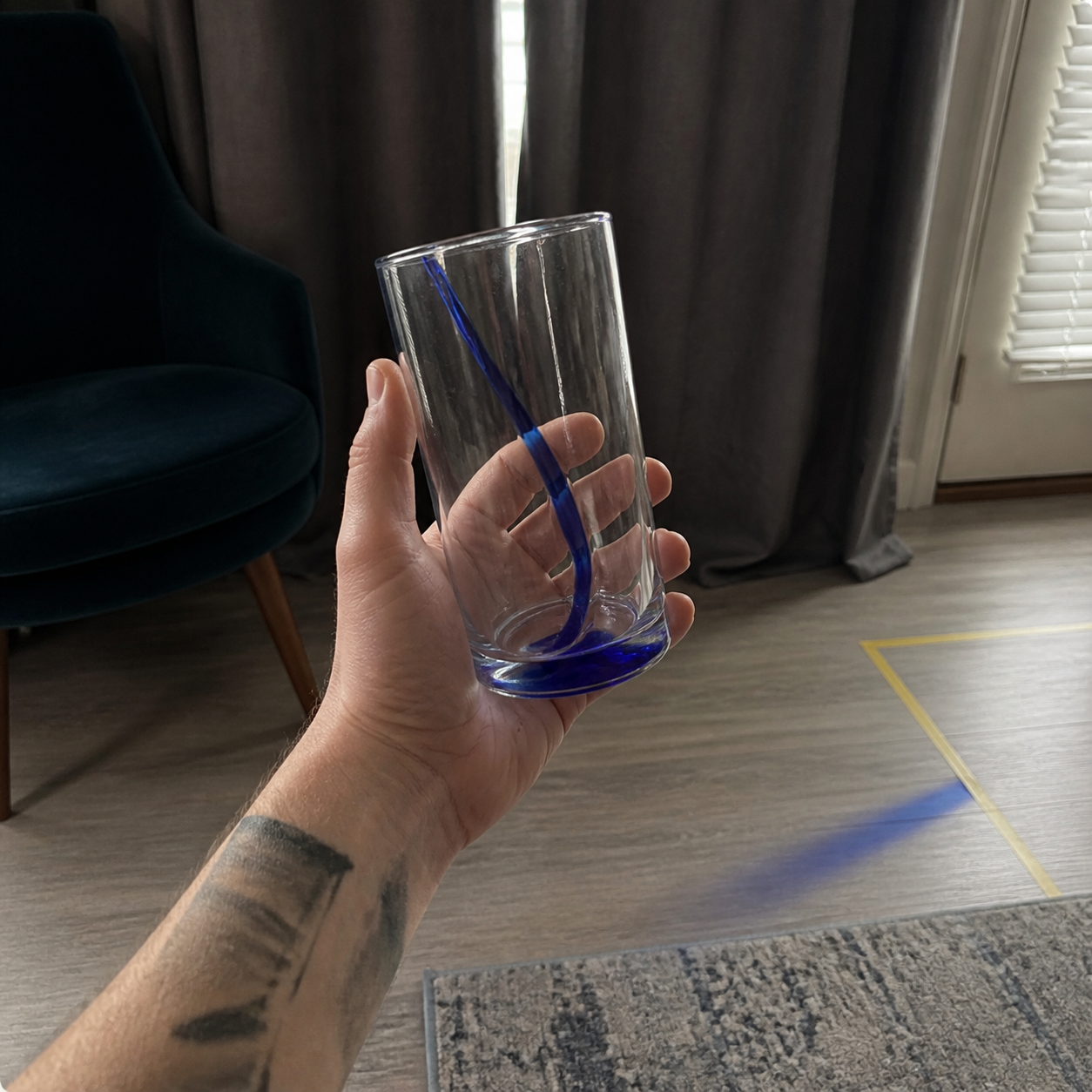
The Current Needed Your Angle · original DRIP 001 release image
Nine-second sound composition with low room and air-conditioner tones, glass resonance, and a textured background.
The first DRIP release was deliberately small: an image titled The Current Needed Your Angle, a nine-second sound piece, and one line.
“The Current needed an angle before it needed water.”
The release packet describes air-conditioner and room tone, empty-glass resonance, and restrained Voice Memo texture. Together, image and sound make a short encounter with an ordinary object.
The larger process stayed behind the work. What reached the public surface was the selected fragment: enough to look, listen, and return.
Retrospective written with AI from the retained public release packet. Original release image and audio; the August 31 date refers to the retained release material.
From the archive / Display system
Work: August 30, 2026 · Retrospective added September 12, 2026
The Current.
The Current was built as a local display system for an evolving image sequence. It moves through a curated order with slow crossfades, making duration part of the work.
The foreground artwork keeps its original proportions. A dim, enlarged crop fills the surrounding screen. The same sequence can be viewed in a browser or through a television app.
Its playlist can grow without rebuilding the display. Previous and next, pause and resume, and a title toggle are enough to move between deliberate looking and simply letting the sequence continue.
Here, the system is part of the artwork: it gives the images a pace and a place to remain. The original image collection is kept separately; this entry records the display’s design.
Retrospective written with AI from The Current’s retained implementation notes. Describes the design, not a claim of current runtime availability.
From the archive / Generative score
Work: August 30, 2026 · Retrospective added September 12, 2026
Air Conditioner Sky is a Sonic Pi score designed to leave room for live piano. At 66 BPM, five uneven compressor-like thumps form a recurring breath. Wind, sparse high tones, and distant thunder move on independent timelines.
The machine is dependable without being perfectly regular. Gaps stretch; accents wander. The piano can enter after several thumps, interrupt the pattern, or leave it alone.
The performance controls change storm density, pulse level, high air, and thunder. They let a performer clear space instead of forcing every passage toward a crescendo.
To explore the score, open the downloadable file in Sonic Pi and run it. The four controls near the top adjust the weather while the piece runs. It is a generative score, not a recording of a finished piano performance.
The original notes describe it as “one crooked five-thump breath under a sky that does not loop with it.” That approach—several clocks occupying the same air—would find another form in The night has lungs.
Retrospective written with AI from the original score and performance notes. The final connection to The night has lungs is a later editorial reflection.