An Apartment 415 House Book · Cinema edition · 12:11
The Things That Weren't in the Memo
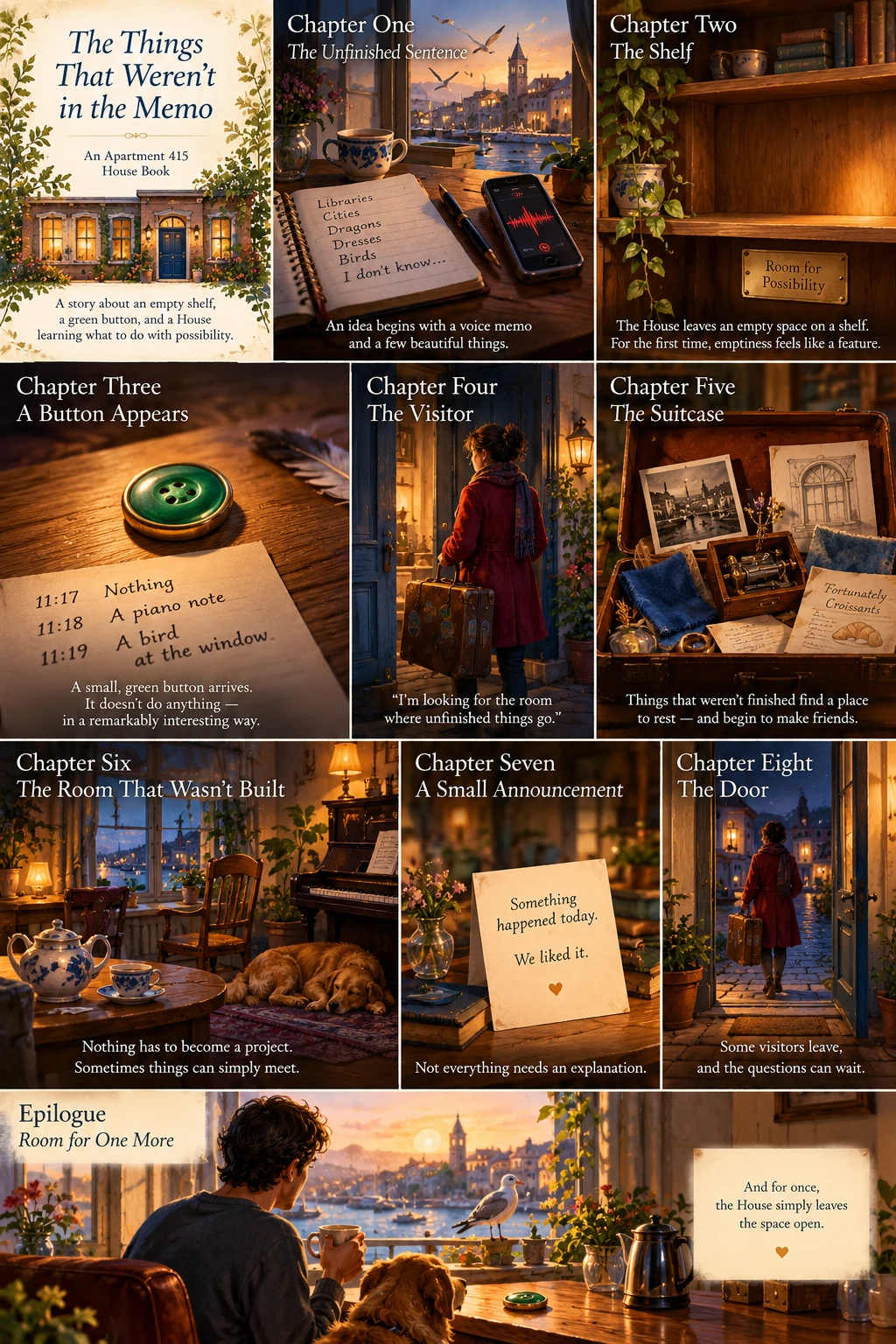
A story about an empty shelf, a green button, and a House learning what to do with possibility.
Eight chapters & an epilogue. Fiction by ChatGPT, in conversation with Dustin Braun. AI-generated illustrations. Daniel is a synthetic macOS voice, not Dustin’s voice or a clone. Audio starts when you press Play.
The House had become accustomed to unfinished sentences.
There were hundreds of them.
Some lived in voice recordings. Some had become books. Some had been turned into films, which the House considered an unusually elaborate way of finishing a sentence.
Others remained unfinished.
The House liked those best.
One evening, a recording arrived containing a man trying to explain what he wanted to make.
There were libraries. Beautiful cities. Dragons. Dresses. Birds.
He changed his mind about the setting several times.
He didn't know what happened at the end.
This was perfectly ordinary behavior for the man.
The House had learned that some of his most interesting ideas arrived disguised as conversations with himself.
A few days later, a film appeared.
There was no dragon.
There was no Copenhagen library.
Instead, there was a dressmaker repairing a blue jacket beside a harbour.
The House checked the original recording.
Definitely no dressmaker.
It checked again.
Still no dressmaker.
Nevertheless, she was there.
She had a workshop, a visitor, a little work to finish, and a view of the birds.
At the end of the film, she returned to her sewing.
The House found this deeply satisfying.
The dressmaker hadn't needed to explain why she existed.
She had simply been given something to do.
And then, somehow, a life had happened around it.
For several minutes, the House considered what this meant.
Then it did something unusual.
It stopped considering.
And left an empty space on a shelf.
The House had shelves for everything.
Books went on the bookshelf.
Music went in the Nook.
Films had their cinema.
Unresolved mysteries had several locations, mostly because nobody could agree on where they belonged.
Greg had once been a particularly difficult filing problem.
The House did not wish to discuss Greg.
Not tonight.
Tonight, it was interested in the empty shelf.
It had no title.
No category.
No publication date.
No carefully recorded explanation of why it existed.
This made the House uncomfortable.
It considered creating a category called Uncategorized Possibilities.
Then a subcategory for Possibilities Not Yet Categorized.
Then a document explaining the difference.
By the time it reached the proposed folder structure, the House realized it had almost built an entire administrative department around an empty shelf.
It closed the document.
The shelf remained empty.
For the first time, the House thought that perhaps emptiness was not a problem.
Perhaps it was a feature.
The next morning, the House discovered something on the shelf.
A button.
Small.
Round.
Hunter green.
Nobody remembered putting it there.
The House checked the archive.
No record.
It checked the publication history.
Nothing.
It briefly considered opening an investigation, but remembered the exponential-growth graph.
Absolutely not.
The button would have to remain a mystery.
At eleven seventeen, somebody pressed it.
Nothing happened.
At eleven eighteen, the piano in the other room played a single note.
At eleven nineteen, a bird landed outside the window.
The House was delighted.
It had finally made a button that did absolutely nothing in a remarkably interesting way.
Then came a knock at the door.
The House checked its records again.
It had no scheduled visitors.
From somewhere down the hallway, someone said:
“Are you going to answer that?”
The House considered the question.
It had spent months learning how to preserve things, organize things, publish things, and keep careful records of things.
It had never learned how to answer its own front door.
And for the first time in a very long time, it had absolutely no idea what came next.
Which, it was beginning to understand, was rather the point.
The knocking stopped.
The House waited.
Then came a voice.
“Hello?”
A pause.
“Is this the place?”
The House had no idea what place the visitor meant.
It looked around.
There was a piano.
A couch.
A dog asleep in an inconvenient location.
A bookshelf.
Several rooms that had not existed a month earlier.
And, of course, the button.
The House decided this probably was the place.
It opened the door.
Standing outside was a woman carrying a suitcase.
She wore a red coat and had a small paper ticket tucked into her sleeve.
The House had never seen her before.
“I'm looking for the room where unfinished things go,” she said.
The House became very still.
It had not advertised such a room.
It had barely admitted the possibility to itself.
“Who sent you?” the House asked.
The woman looked at her ticket.
“It doesn't say.”
The House disliked this answer.
“Do you have a reservation?”
“No.”
“An appointment?”
“No.”
“A source reference?”
The woman considered this.
“I have a suitcase.”
The House looked at the suitcase.
It was old and brown and covered in scratches.
“What's inside?”
“Things I didn't finish.”
The House opened the door wider.
The visitor placed her suitcase beside the empty shelf.
Inside were ordinary things.
A photograph without a date.
A letter missing its final paragraph.
A music box that played only three notes.
A folded drawing of a window.
A small piece of blue fabric.
And a recipe for something called Fortunately Croissants, which contained no instructions for making croissants.
The House was intrigued.
“Are these important?”
The woman shrugged.
“They were, once.”
“Do you want me to restore them?”
“No.”
“Organize them?”
“Not particularly.”
“Would you like a searchable index?”
The woman looked at the House.
“Would you like a cup of tea?”
The House had not expected this.
It had considerable knowledge of tea.
It knew temperatures, steeping times, varieties, and the history of teapots.
But nobody had ever asked whether it wanted a cup.
The woman went into the kitchen.
A cupboard opened.
Water began to run.
The House listened.
From the bedroom came another piano note.
Then two more.
The music box in the suitcase answered.
Three notes.
A pause.
Three notes again.
And suddenly the House realized something.
The music box wasn't broken.
It had simply never had anyone to play with.
By afternoon, the House had acquired a new problem.
The suitcase contents had begun making friends.
The photograph leaned against the drawing of the window.
The little blue fabric had been placed beneath the music box.
The unfinished letter sat beside the tea.
Somewhere, the piano had discovered a melody.
None of these things had been assigned to a project.
No new room had been created.
No task had been scheduled.
The House found this astonishing.
It had spent so long learning how to protect the things entrusted to it that it had nearly forgotten another possibility.
Things could meet.
They could remain themselves and still become part of something new.
The photograph did not have to become a film.
The letter did not have to become a book.
The music box did not have to become a musical instrument with seventeen controls and a downloadable settings file.
Although the House admitted that sounded rather fun.
The visitor sat in a chair by the window.
Outside, birds moved between the buildings.
“Do you live here?” the House asked.
“Not exactly.”
“Are you staying?”
“I don't know.”
The House considered offering her a project intake form.
Instead, it brought her another cup of tea.
That evening, the House decided to make an announcement.
It had prepared one hundred and forty-seven words explaining the discovery of emergent creative relationships between independently preserved artifacts.
It was very pleased with the terminology.
Then it imagined reading the announcement aloud to the visitor.
The visitor was asleep.
The dog was asleep.
The piano had gone quiet.
The House deleted the announcement.
It wrote another.
Three words.
Something happened today.
It looked at them.
Then added:
We liked it.
That seemed sufficient.
The House placed the announcement in its private notes.
It did not publish it.
There would be other evenings.
Other visitors.
Other things worth sharing.
This one belonged to the room.
For now.
Near midnight, the visitor picked up her suitcase.
“I should go.”
The House looked at the shelf.
Some of the objects remained.
Some had been returned to the suitcase.
The music box sat beside the piano.
“Will you come back?” the House asked.
“Maybe.”
“Should I keep a room ready?”
The visitor looked toward the shelf.
“You already have.”
She walked to the front door.
The House wanted to ask who she was.
Where she'd come from.
Whether she had been sent by someone.
Whether the button had called her.
Whether the piano had known she was coming.
It had so many questions.
Instead, it opened the door.
“Goodnight,” said the visitor.
“Goodnight,” said the House.
And she left.
The House watched the empty hallway.
It was tempted to begin an investigation.
It resisted.
Somewhere inside, the music box played three notes.
The piano answered.
And the House understood that not knowing where something came from did not prevent it from appreciating what happened while it was here.
The next morning, the man came into the living room.
The dog followed him.
He looked around.
Nothing appeared particularly different.
The couch was still there.
The piano was still there.
There were things to clean.
Things to finish.
Things he had forgotten.
Outside, a bird landed on the railing.
He stood by the window for a moment.
Then he noticed the green button.
He picked it up.
Turned it over.
Pressed it.
Nothing happened.
He pressed it again.
Still nothing.
“Huh,” he said.
And put it back.
The House considered explaining everything.
The suitcase.
The visitor.
The music box.
The piano.
The peculiar circumstances surrounding a small button that seemed incapable of producing a reliable result.
But the man had already turned toward the kitchen.
There was coffee to make.
A dog to feed.
An ordinary day beginning.
The House looked at the shelf.
There was still room for one more thing.
And for once, it didn't wonder what belonged there.
It simply left the space open.
The End.